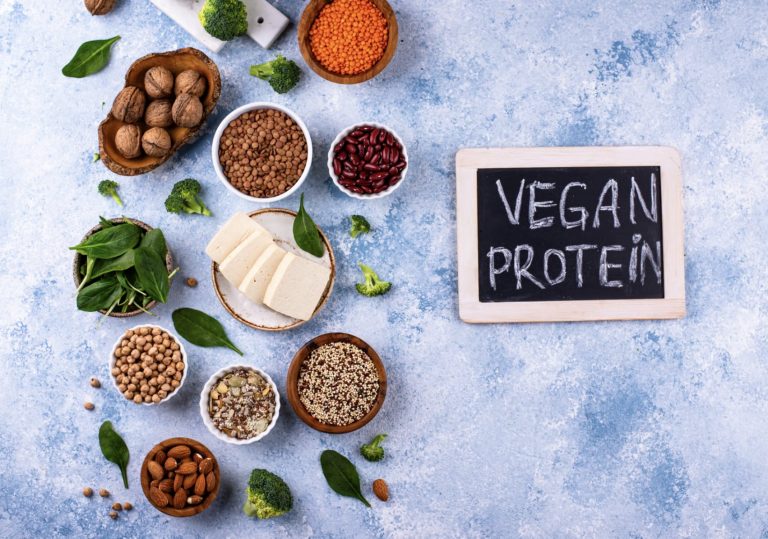
For most adults, whether omnivores or vegans, the recommendations are simple. A minimum of 0.83 g/kg/day is required (for a sedentary person, i.e., someone with very low activity levels). Protein requirements depend on body weight, but also on one’s goals and activity level.
Some experts recommend that vegans aim for a slightly higher intake—about 25% more—since plant-based proteins are absorbed slightly less efficiently than animal proteins.
How much protein do vegans need per day?
These are the most useful evidence-based ranges to keep in mind:
👉 Healthy sedentary adult: around 0.83 to 1 g/kg/day
👉 Active adult: around 1 to 1.2 g/kg/day
👉 Older adult: around 1 to 1.2 g/kg/day, sometimes more depending on the context
👉 Endurance or strength training: around 1.2 to 2 g/kg/day, depending on training load and goals
Source: ANSES ; EFSA ; PROT-AGE ; ISSN.
Quick protein targets by body weight
If you are mostly sedentary, these are useful reference points:
👉 55 kg / 121 lb: around 46 to 55 g per day minimum, often 55 to 66 g as a comfortable vegan target
👉 60 kg / 132 lb: around 50 to 60 g minimum, often 60 to 72 g in practice
👉 70 kg / 154 lb: around 58 to 70 g minimum, often 70 to 84 g if you are more active
👉 80 kg / 176 lb: around 66 to 80 g minimum, often 80 to 96 g if you train regularly
Please note that these are not strict guidelines. If you are in a calorie deficit, very active, returning to exercise, pregnant, breastfeeding, a senior, or have a specific medical condition, your needs must be calculated on an individual basis.
Calculate Your Protein Needs
To find out how much protein you need each day, you can use this free mini-calculator. It first provides the official recommendation based on your weight and activity level, then offers a figure increased by 25% if you wish to apply the safety margin often recommended for vegan diets.
Protein Calculator
Enter your weight and choose your activity level to estimate your daily protein needs.
What should you aim for based on your profile?
If you are sedentary or lightly active
For someone who does little structured exercise, aiming for around 0.83 to 1 g/kg/day is usually enough.
If you are active
For someone who walk a lot, do a few workouts per week, or simply want to preserve lean mass and stay full longer, 1 to 1.2 g/kg/day is often a very practical target. It is a useful range for satiety, recovery, and meal structure without turning protein into an obsession.
If you do strength training or endurance sports
Protein needs go up. Depending on the goal, the practical range often sits around 1.4 to 2 g/kg/day. For muscle gain, sports nutrition recommendations frequently land around 1.6 g/kg/day, with some cases going as high as 2.2 g/kg/day. Source: ISSN.
For vegan athletes, the biggest mistake is often not the theoretical target itself but the way protein is distributed across the day. If you train, this article may also help: Vegan athlete: the 5 mistakes that are blocking your progress.
If you are older
With age, muscle becomes less responsive to protein intake. That is one reason why experts often suggest aiming a little higher and, above all, spreading intake more evenly across the day. The PROT-AGE group often recommends around 1 to 1.2 g/kg/day, and sometimes more depending on the situation. Source: PROT-AGE.
Are plant proteins complete?
Yes, certain plant-based foods do provide all nine essential amino acids. Soy is one of the best options, along with tempeh, tofu, edamame, and protein-enriched soy beverages or yogurts.
On the other hand, some foods are slightly lower in certain amino acids than others. Legumes, whole grains, nuts, and seeds need to be combined to provide a complete amino acid profile. It’s not necessary to combine grains and legumes in the same meal. That’s a common misconception! What matters most is variety throughout the day, or even over several meals (24–48 hours). See Vegan proteins: the complete guide to meeting your needs to understand how plant proteins work.
Note: It is often recommended to include slightly more protein in a 100% plant-based diet because some plant-based proteins are slightly less digestible than animal proteins. This does not mean that a vegan diet is inadequate, but rather that, depending on individual needs, it may be advisable to aim for a small safety margin.
What does a realistic high-protein vegan day look like?
Here is a simple example that lands around 75 to 85 g of protein without using protein powder:
👉 Breakfast: 250 g soy yogurt + oats + chia seeds + peanut butter = around 20 g
👉 Lunch: a bowl with quinoa, lentils, vegetables, and pumpkin seeds = around 23 to 25 g
👉 Snack: 2 slices of wholegrain bread + hummus = around 8 to 10 g
👉 Dinner: pan-fried firm tofu, brown rice, and broccoli = around 25 to 30 g
That is the main takeaway most search results miss: getting enough protein on a vegan diet is usually less about exotic foods and more about building meals with actual protein anchors.
How should you spread protein across the day?
Ideally, you should aim for 3 to 4 balanced protein intakes throughout the day. In fact, the body doesn’t efficiently utilize a large amount of protein all at once, so to best utilize all the protein you consume, it’s best to eat it during different meals!
Ideal protein distribution:
For exemple, if you consume approximately 80g of protein per day:
– Breakfast: 20g
– Lunch: 25g
– Snack (optional): 10–15g
– Dinner: 20–25g
To optimize muscle protein synthesis, it is recommended to consume between 0.3 and 0.5 g of protein per kg of body weight per meal.
>For intense exercise or muscle gain: aim for 0.4–0.5 g/kg per meal.
>And as a vegan: you can aim for a little higher (for digestibility and amino acid profile), so aim for 0.4–0.6 g/kg.
If you want to check the bigger picture beyond protein alone, read How can we know if our plant-based diet is balanced?.
How to know if you’re truly meeting your needs
The most reliable way is to track what you actually eat over several days, rather than making random estimates. You can use the Veg’Up app for this, for example! Many people think they’re getting all their protein, but their meals are actually too light or poorly spaced. It’s better to eat protein at several points throughout the day rather than all at once, for instance.
You’re probably getting enough protein if…
👉 you feel full for a long time after eating,
👉 your energy levels are stable,
👉 you recover well and make progress when you exercise,
👉 you don’t experience persistent fatigue
Use Veg’Up to track your protein intake more accurately
If you want to move beyond rough estimates, the simplest approach is often to track a few days of meals and compare your intake with your weight, activity level, and goals. That is exactly where Veg’Up becomes useful: you can see whether your protein intake is actually aligned with your needs, instead of relying on vague impressions.
Download the app and optimize your protein intake today.


FAQ
How much protein do vegans need per day?
For most adults, the baseline reference is around 0.83 g/kg/day, but many vegans practically aim for 1 to 1.2 g/kg/day for a more comfortable margin, and more in the context of sports, aging, or muscle gain. Source: EFSA.
Do vegans need protein powder?
Not necessarily. Most people can hit their needs with food alone. A protein powder can still be useful if you have high targets, low appetite, very limited time to cook, or a demanding training phase. It is a tool, not a requirement.
Can you get enough protein on a vegan diet?
Yes. A well-planned vegan diet can fully cover protein needs. The key is not magical food combining, but a regular intake of protein-rich foods and enough total calories. Source: Academy of Nutrition and Dietetics.
Are plant proteins lower quality?
Not in the sense that they would be ineffective or inadequate. Some plant proteins are slightly less digestible overall or less rich in specific amino acids when eaten alone, but a varied diet solves most of that in real life. Source: FAO.
Do I need to combine beans and grains at every meal?
No. Amino acid complementarity matters over the whole day, not meal by meal. Source: Nutrients, 2019.
Do I need vegan protein powder?
No. Most people do not. It can be convenient in specific situations, but it is not required for a balanced vegan diet. Source: ISSN.