How much protein does our body need?
The official recommendations are as follows:
👉 0.83 g/kg/day for adults (ANSES, EFSA)
👉 1.0 to 1.2 g/kg/day for older adults (PROT-AGE)
👉 1.6 to 2 g/kg/day for muscle gain (ISSN)
This means in practice:
👉 for a 60 kg person → around 50 g minimum
👉 for a 75 kg person → around 60 g minimum
👉 for a 75 kg athlete → up to 120–150 g
How much vegan protein do you need per day?
Protein requirements are generally the same whether you are omnivore, vegetarian, or vegan. However, some experts recommend aiming slightly higher on a vegan diet, because plant proteins tend to have a slightly lower digestibility than animal proteins, and a less optimal amino acid profile in some cases.
These differences are notably documented by the Food and Agriculture Organization (FAO), which recommends evaluating protein quality based on digestible amino acids (DIAAS method).
In this context, the Academy of Nutrition and Dietetics states that protein needs may be slightly higher for people following vegetarian or vegan diets, particularly due to the digestibility of plant proteins.
To account for these differences, many experts recommend slightly increasing intake:
👉 vegan adult → around 1.0 g/kg/day
👉 older adults → 1.2 to 1.5 g/kg/day
👉 vegan athletes → 1.6 to 2.2 g/kg/day
Is it necessary to increase protein intake?
No.
A well-structured, varied plant-based diet rich in quality sources (soy, legumes, whole grains) can easily meet protein needs.
Scientific studies also show that when total protein intake is sufficient, muscle mass and performance outcomes are comparable between plant-based and omnivorous diets (Hevia-Larraín et al., Sports Medicine, 2021).
Vegan protein: quality, amino acids and digestibility
Unfortunately, not all proteins are equal.
Plant proteins are made of amino acids, and 9 of them are essential and cannot be produced by the body. If even one essential amino acid is missing, the body cannot function optimally.
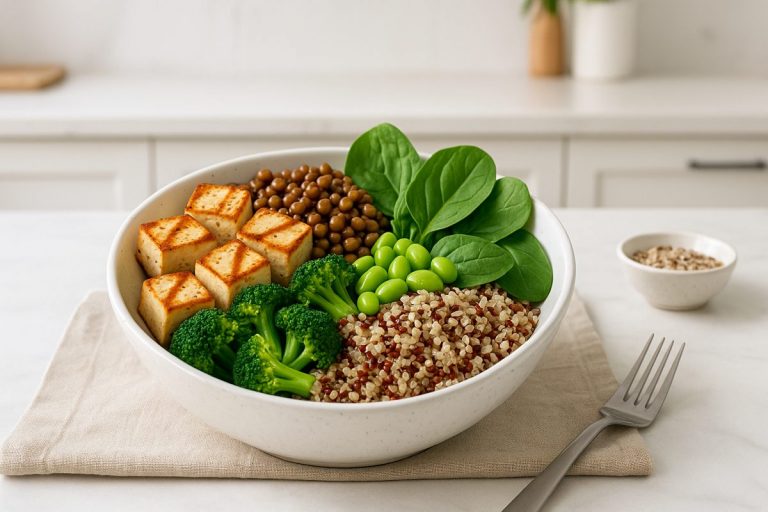
In the world of vegan protein, only a few are considered complete: soy (tofu, tempeh, edamame, TVP), quinoa, hemp seeds, buckwheat, and amaranth.
For others, there is always a limiting amino acid:
👉 cereals are low in lysine
👉 legumes are low in methionine
To evaluate protein quality, the FAO recommends using the DIAAS score, which takes into account both amino acid profile and digestibility.
DIAAS: how to measure vegan protein quality
This is the reference method recommended by the FAO. Unlike PDCAAS, the previous standard, it does not cap scores at 1.0, evaluates each digestible amino acid individually, and better reflects the true quality of a protein.
The DIAAS (Digestible Indispensable Amino Acid Score) measures the amount of essential amino acids actually digested and absorbed by your body. The advantage is that it reflects not just what you eat, but what your body truly uses.
How to interpret a DIAAS score?
👉 Score > 1.0: excellent protein quality
👉 Score 0.75 – 1.0: good quality
👉 Score 0.5 – 0.75: moderate quality
👉 Score < 0.5: low quality
For example, in a vegetarian diet, eggs (1.13) and milk (1.18) have the highest DIAAS. In a vegan diet, soy ranks highest (0.9 to 1.0).
Comparison table of vegan protein sources
(On mobile, scroll right 👉 to view the full table)
| Source | Protein quality (estimated DIAAS) | Limiting amino acid | Digestibility | Protein density | Best for |
|---|---|---|---|---|---|
| Soy (tofu, tempeh) | High (≈ 0.9 – 1.0) | None | Good | High | Daily base |
| Pea | Moderate to high (≈ 0.7 – 0.8) | Methionine | Good | High | Supplements / sports |
| Rice | Moderate (≈ 0.6 – 0.7) | Lysine | Very good | Moderate | Complements pea protein |
| Wheat (seitan) | Moderate (≈ 0.5 – 0.6) | Lysine | Very good | Very high | Boost protein intake |
| Lentils / chickpeas | Moderate (≈ 0.5 – 0.7) | Methionine | Moderate | Moderate | Nutritional base |
| Quinoa | Good (≈ 0.7 – 0.8) | None | Good | Moderate | Balanced alternative |
| Seeds / nuts | Variable | Lysine | Moderate | Low to moderate | Nutritional complement |
Thanks to DIAAS, we can see that soy remains the most complete source, with a score of 0.9 to 1. And that the combination (peas + rice, legumes + cereals) is relevant.
Why DIAAS changes everything in a vegan diet
Without DIAAS, using a traditional approach: you count the grams of protein on your plate, you reach your target, and you think you’re good.
BUT: with DIAAS, you realize that you’re not completely fine, because proteins are less efficiently used by the body due to an imbalance in amino acids.
Example: you eat 100g of legumes.
On paper, you have about 10g of protein. In reality, since methionine is low in legumes, your body cannot fully use those 10g. For full utilization, you need to complement your intake with cereals. By adding 100g of rice, which is rich in methionine, in combination with your legumes, you obtain a much more balanced amino acid profile that is truly usable by the body!
These concepts are now used in nutrition research to assess the true quality of proteins, especially in plant-based diets.
What are the best vegan protein sources?
There are a few foods that are very high in vegan protein and allow you to easily reach your goals without any effort:
👉 tofu
👉 tempeh
👉 textured soy protein
👉 seitan
👉 edamame (less well known, edamame is a preparation of immature soybeans)
And there are staple foods which, when combined, also help you reach your protein intake:
👉 legumes such as lentils (green, red…), chickpeas, beans (red, green, white…)
👉 cereals such as oats, whole wheat pasta, brown rice
And supplements, which help complete missing amino acids and quickly increase the vegan protein content of your meals:
👉 different seeds: sunflower seeds, hemp seeds, sesame seeds…
👉 nuts: cashews, almonds, hazelnuts, Brazil nuts…
A simple strategy: take 1 main protein source per meal + 1 complementary source.
Do you absolutely need to combine cereals and legumes in the same meal for amino acids to complement each other properly?
No!
ANSES states that if intake is sufficient and dietary diversity covers nutritional needs, then strict combination at every meal is not necessary. So yes, complementarity is essential and required, but it can be achieved over the course of a day!
So rest assured, you won’t need to eat cereals + legumes at every meal. You can vary: cereals at lunch, legumes in the evening! The key is to have a variety of vegan protein sources over 24–48 hours.
Should you take vegan protein powder?
Normally, with a vegan diet and being sufficiently informed, you can meet your needs without using protein powder. Scientific recommendations are clear: a well-planned plant-based diet is sufficient to meet daily requirements (Academy of Nutrition and Dietetics, 2016).
When can protein powder be useful?
👉 High goal of muscle gain
👉 Lack of time to cook
👉 Difficulty eating enough
👉 Caloric deficit
The problem with protein powders is that they are generally ultra-processed, with added sugar or various additives. They can help occasionally, but should not be relied upon as the foundation of a balanced vegan diet.
Veg’Up Nutrition: the solution to optimize your vegan protein intake
Today, the challenge is not finding vegan protein, but knowing whether you are actually consuming enough and whether it is well balanced. This is exactly the problem that Veg’Up Nutrition was created to solve. Unlike traditional apps, Veg’Up doesn’t just count protein.
In just a few seconds, you can:
👉 Check whether you are truly meeting your needs
👉 Analyze your protein sources (legumes, cereals, seeds…) with a daily chart
👉 Improve your amino acid profile without complex calculations
👉 Adjust your intake based on your goals
With Veg’Up, you won’t just eat vegan — you’ll truly learn how to structure your diet!
Download the app and optimize your vegan protein intake today!


FAQ – Vegan protein
Can you get enough protein on a vegan diet?
Yes, a well-planned plant-based diet can meet all protein requirements according to scientific recommendations.
What are the best vegan protein sources?
Soy (tofu, tempeh), legumes, and whole grains are the main plant-based protein sources.
Do you need to combine plant proteins?
Yes, but not necessarily in the same meal. Variety throughout the day is enough.
Are vegan proteins less effective?
No, as long as you meet your needs and vary your sources.